
Automotive and Transport
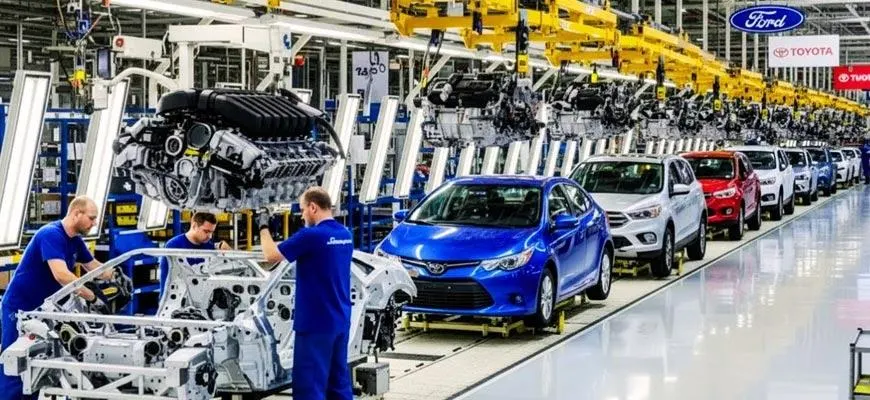
Ferritic widths feed the exhaust line: Stainless Steel 409 Strips at the cold end, 439, and 441, where welded joints face heat cycling. Hose clamps and spring clips call for 301, and 430 covers trim.
We are Riddhi Siddhi Impex, an ISO 9001, ISO 14001, and ISO 45001-certified stainless steel strips manufacturer and supplier operating from Mumbai since 2002. We slit every strip in-house from mill-certified Stainless Steel coils to ASTM, ASME, and AMS standards, with precision slitting covering any width from 3 mm to 2000 mm. Ready stock across 15 grades, a monthly supply capacity of 400 to 500 tonnes, and dispatch within 4 to 5 days keep fabrication lines fed.
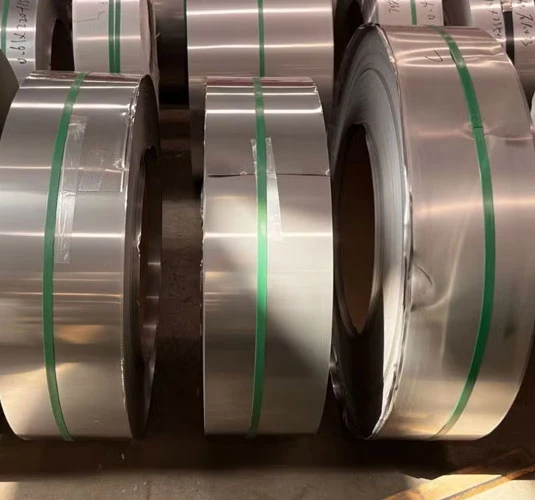
Stainless steel strips are narrow, flat-rolled products made by slitting a wider coil into exact widths, then rewinding each width as a slit coil for continuous press feeding. Trade practice and EN standards classify flat products under 2000 mm wide as strip. Cold-rolled stainless steel strips carry tighter gauge control and a smoother face than hot-rolled material, so they dominate spring, stamping, and precision work.
Our slitting lines draw on around 1000 tonnes of ready stock at Mumbai and Taloja. Thickness runs from 0.03 mm to 5 mm: hot-rolled pickled material covers the heavier gauges, and thin stainless steel strips at the foil end are handled as precision work. Coils wind on IDs of 150 mm to 610 mm, with ODs up to 1800 mm. Buyers choose slit, mill, deburred, or round edges. Mill documentation follows every coil through to the finished width.
We slit 15 stainless steel winding strip grades spanning three families: austenitic, ferritic, and martensitic.
Austenitic grades account for ten of the fifteen and cover most general fabrication, chemical, and heat-facing strip duties.
Rapid work-hardening defines Stainless Steel 301 Strips. Spring, clip, and clamp makers order them in the cold-rolled tempers ASTM A666 covers.
View gradeStainless Steel 304 Strips outsell every other width we slit. The grade balances corrosion resistance, formability, and price.
View gradeA lower carbon ceiling lets Stainless Steel 304L Strips weld without carbide precipitation.
View gradeFurnace components lean on Stainless Steel 309 Strips for scaling resistance at elevated temperatures.
View gradeKiln and radiant tube work keep Stainless Steel 310S Strips in sustained high-temperature service.
View gradeMolybdenum gives Stainless Steel 316L Strips their chloride resistance. Low carbon keeps welded edges free of sensitisation.
View gradeHigher molybdenum again moves Stainless Steel 317L Strips into scrubber duty and harsher chemical streams.
View gradeTitanium stabilisation protects Stainless Steel 321 Strips against intergranular corrosion after welding or long heat exposure.
View gradeStainless Steel 347 Strips rely on niobium for the same stabilising job. Refinery fabricators weld them for hot service.
View gradeSulphuric acid plants specify Stainless Steel 904L Strips: copper in the chemistry, backed by high nickel and molybdenum, blunts the acid's attack.
View gradeFour ferritic grades sit in the range; low nickel keeps their pricing steady.
Exhaust tubing and heat shields consume most of the Stainless Steel 409 Strips we slit, at minimum alloy cost.
View gradeStainless Steel 430 Strips suit appliance panels and interior trim where a clean, rolled surface matters most.
View gradeA titanium addition keeps Stainless Steel 439 Strips weldable for exhaust and heat exchanger work.
View gradeStabilised twice, with titanium and niobium, Stainless Steel 441 Strips keep weld integrity through exhaust heat cycles.
View gradeMartensitic strip hardens through heat treatment rather than cold rolling; one grade covers this family.
We supply SS strips in 3 finishes; the three below ship most often, with Bright Annealed (BA), 2B, and Scotch-Brite arranged across the range.
 BA
BA
Bright annealing leaves a polished, mirror-like surface straight off the line, so appliance parts skip buffing.
 2B
2B
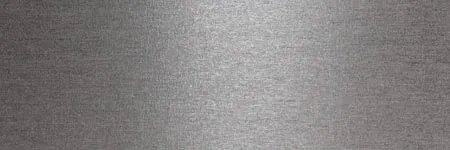
Most cold-rolled stainless steel strips leave as 2B: annealed, pickled, and lightly re-rolled to a smooth, semi-reflective face.
 No. 4
No. 4
Buyers wanting brushed stainless steel strips specify Scotch-Brite. The uniform texture doesn't show fingerprints or handling marks on visible parts.
3 industrial sectors commonly use stainless steel metal strips, leaving our slitters. Corrosion exposure and forming route decide the grade.
Ferritic widths feed the exhaust line: Stainless Steel 409 Strips at the cold end, 439, and 441, where welded joints face heat cycling. Hose clamps and spring clips call for 301, and 430 covers trim.

Processing lines and pharmaceutical equipment run on Stainless Steel 304 Strips through daily washdown chemistry. Where brines or stronger cleaning agents contact the part, buyers step up to 316L.

Gasket winding, bellows, and heat exchanger seal strip face hot, aggressive media. Stainless Steel 316L and 317L Strips handle chloride-bearing streams, 321 and 347 take welded high-temperature spots, and 904L serves sulphuric acid circuits.
Traceable paperwork moves with every consignment from the source coil to the slit width. Riddhi Siddhi Impex holds three ISO certifications behind its slitting and supply operations.
An EN 10204 Type 3.1 mill test certificate accompanies each dispatch, traced to the mill heat. Type 3.2 is available on request.
Quality management from slitting through inspection to dispatch runs under our ISO 9001:2015 certification.
ISO 14001:2015 governs our environmental practices, covering storage, processing, and waste handling.
Workplace health and safety across the warehouse and slitting lines operates under ISO 45001:2018.
Flat-rolled stainless product 600 mm or wider falls under HS heading 7219, and narrower material under 7220. Custom-slit strip usually runs under 600 mm, so most orders ship under 7220. Confirm the final subheading with your customs broker.
Yes. We slit any width between 3 mm and 2000 mm, holding a width tolerance of ±0.1 mm. Coil ID runs from 150 mm to 610 mm, with OD up to 1800 mm.
Riddhi Siddhi Impex is one of the most reliable Stainless Steel strip manufacturers and suppliers from Mumbai since 2002, serving buyers across India and abroad. Call or WhatsApp our team; get a quote within 24 hours.